
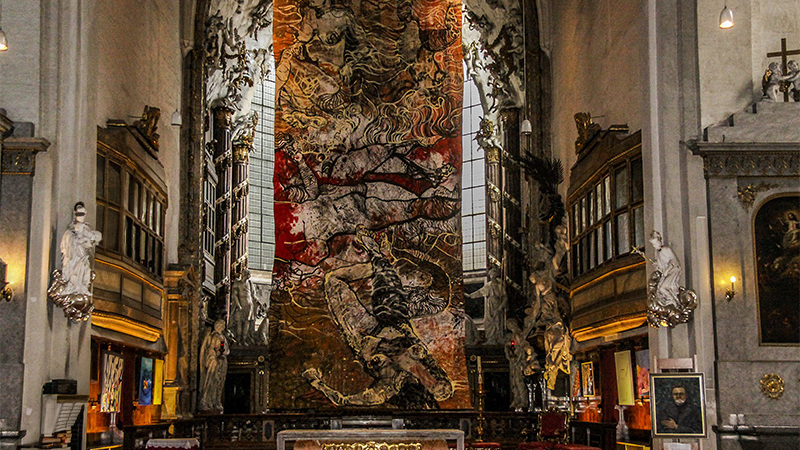
Lenten veil 2026 in St. Michael's Church: A sign against human trafficking
Zhanina Marinova (born 1994, Varna, Bulgaria) lives and works in Vienna. She studied fine art, specialising in graphic art and printmaking, at the University of Applied Arts Vienna. She has been a member of the Vienna Künstlerhaus since 2018. Her work is imbued with a deep engagement with social issues and societal injustices. Marinova herself describes her artwork as follows:
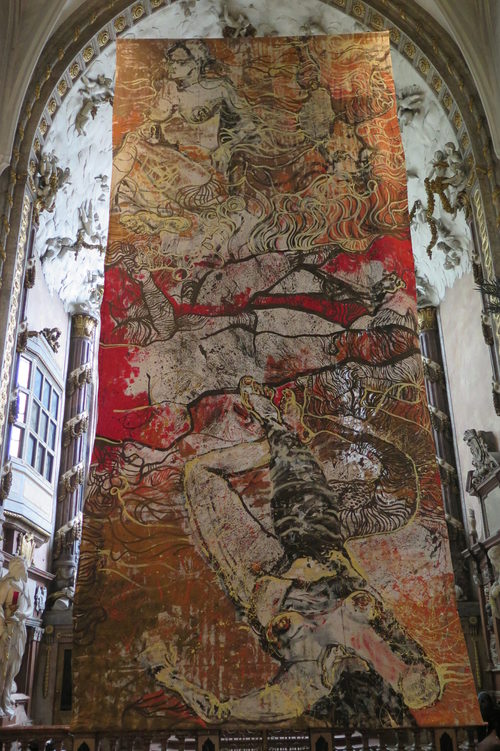
„Even though we often forget it... human trafficking is a “creature” that lives and grows silently around us. The victims: invisible people, hidden from the eyes of society. Hidden behind bars and walls, the body becomes currency. The endless black lines symbolise the constant vortex of hopelessness in which these people sink. The “bars” that hold them captive. The chains that bind them – their existence. The veils that cover our eyes...“
The black lines of her Lenten veil represent the vortex of hopelessness, while the bars and chains symbolise imprisonment and disenfranchisement. The work reveals what often happens in secret. It urges us not to look away, but to acknowledge the reality of exploitation and human trafficking.
Salvatorians' commitment to combating exploitation
The Salvatorians have been publicly campaigning against exploitation and human trafficking for many years. Salvatorian Provincial Fr. Márton Gál SDS, parish moderator of St. Michael's, emphasises that the religious community is consciously setting an example and taking concrete steps to raise awareness in society with its ‘Ware Mensch’ (Human Goods) initiative and as co-founder of the ‘Platform against Exploitation and Human Trafficking’.
The parish of St. Michael deliberately makes its ‘tourist church’ available as a space for reflection. The church should not only be a place of prayer, but also a space for social issues and challenges.
Gál refers to various forms of disenfranchisement as ‘wounds in society’. These manifest themselves, for example, in the humiliating upbringing of children or in attempts to break people's will. Even within the Church, there is cause for self-critical reflection – for example, with regard to the role of women.
Jesus' message remains the guiding principle of Christian action: ‘Whatever you did for one of the least of these brothers and sisters of mine, you did for me.’ These words call on us not to overlook the suffering of the weakest among us.
Human trafficking in Austria
Due to its location in Central Europe, Austria serves as a transit and destination country for human trafficking. Victims often come from poorer EU countries or third countries. Every year, up to 350 victims are cared for by domestic victim protection agencies and NGOs.
Among them are children, women and men of different origins and ethnicities – many of whom are victims of sexual exploitation. Human trafficking is not a distant reality, but also directly affects our society.
Art as a call to action
With the Lenten veil, the Salvatorians combine art and faith to make a powerful appeal: look, become sensitive, take responsibility.
The St Michael's Church thus opens up a space that invites not only prayer, but also reflection and action – in the service of the dignity of every single human being.